
Does Urgent Care Perform EKGs / ECGs?
Many urgent care centers can perform an EKG, also called an ECG, during a same-day visit. This test records your heart’s electrical activity. It helps a clinician assess symptoms like palpitations, mild chest discomfort, dizziness, or shortness of breath.
The key is knowing when an urgent care EKG is appropriate and when symptoms require the emergency room instead.
Do urgent care centers perform EKGs or ECGs?
Yes, many urgent care centers offer on-site EKG services, although availability can vary by location. The Urgent Care Association expects many certified urgent care centers to obtain and interpret EKGs on site. This shows how common this service is in modern urgent care settings.
An urgent care EKG may be used when a provider needs a quick look at your heart rhythm during a non-life-threatening visit. It is not the same as a full cardiology workup. It does not replace emergency care when symptoms suggest a heart attack or another serious event.
You may see this service listed as:
- EKG services
- ECG testing
- 12-lead EKG
- Urgent care EKG
- Urgent care EKG/ECGs
- Heart rhythm testing
EKG and ECG mean the same test
EKG and ECG both mean an electrocardiogram. It is a quick test that records your heart’s electrical signals.
The two acronyms exist because of language history. ECG comes from the English spelling, “electrocardiogram.” EKG comes from the German spelling, “Elektrokardiogramm,” where the “k” sound appears in the word. Both terms mean the same thing, with EKG tracing back to the German version.
In everyday U.S. medical settings, you may hear either term. If a clinic advertises ECG testing and another advertises EKG testing, they are generally talking about the same test.
Urgent care is not a replacement for ongoing heart care
Urgent care can offer a same-day check for some symptoms. It is not meant to manage chronic or complex heart conditions over time. If you have a long-term heart problem, it is important to see your primary care clinician regularly.
When needed, you should also see a cardiologist. In general, use urgent care for short-term concerns and an initial check.
Plan on primary care or cardiology for:
- Long-term treatment planning for conditions like atrial fibrillation, heart failure, coronary artery disease, or cardiomyopathy
- Medication management that requires ongoing monitoring (for example, dose adjustments or side-effect tracking)
- Follow-up testing such as echocardiograms, stress tests, longer-term rhythm monitoring, or advanced imaging
- Managing risk factors such as high blood pressure, high cholesterol, diabetes, or smoking cessation
- Coordinating specialist care after abnormal EKG findings
If an urgent care visit identifies a concern, the clinician may advise ER evaluation or refer you to your primary care provider or a cardiologist for a more complete workup.
When should you go to the ER instead?
Go to the emergency room or dial 911 immediately if you think you may be having a medical emergency. Urgent care is not appropriate for heart attack symptoms or heart attack treatment.
The American Heart Association advises calling 911 when heart attack, stroke, cardiac arrest, or other emergency warning signs are present.
Do not choose urgent care if you have symptoms such as:
- Severe, crushing, or worsening chest pain
- Chest pain spreading to the arm, jaw, neck, shoulder, or back
- Sudden severe shortness of breath
- Fainting, loss of consciousness, or inability to stay alert
- New confusion, trouble speaking, facial drooping, or arm weakness
- Blue lips, severe sweating, or a feeling of impending doom with chest symptoms
- A fast or irregular heartbeat with severe weakness, chest pain, or fainting
Emergency departments are equipped for advanced cardiac evaluation and treatment. They can provide continuous monitoring, emergency medications, blood tests, imaging, specialist consultation, and hospital admission if needed. An urgent care clinic may be able to run an EKG, but it is not designed to manage an active heart attack.
Reasons people use urgent care for an EKG
Urgent care can be a practical choice when symptoms are concerning but not clearly life-threatening. For example, someone with mild palpitations, intermittent fluttering, or dizziness may want prompt evaluation without waiting days for a primary care appointment. In that situation, an urgent care provider can review symptoms, check vital signs, perform an exam, and decide whether an EKG is appropriate.
People may also use urgent care EKG services for convenience. Many urgent care centers accept walk-ins, offer evening or weekend hours, and can complete basic diagnostic testing during the same visit. The Urgent Care Association notes that urgent care centers often provide diagnostic services such as X-rays, lab testing, and EKGs on site, allowing faster evaluation for many non-emergency conditions.
Common reasons for an urgent care EKG may include:
- Heart palpitations or a fluttering sensation
- Mild chest discomfort that is not severe or worsening
- Dizziness or lightheadedness
- Shortness of breath without severe distress
- A fast, slow, or irregular pulse
- Medication-related heart rhythm concerns
- Pre-operative, school, work, or sports clearance when requested
- Follow-up after a provider recommends an ECG or EKG
The benefit is speed and access. The limitation is scope. If your symptoms look serious, the urgent care team may call emergency services or send you to the ER for more complete testing.
What happens during an urgent care EKG
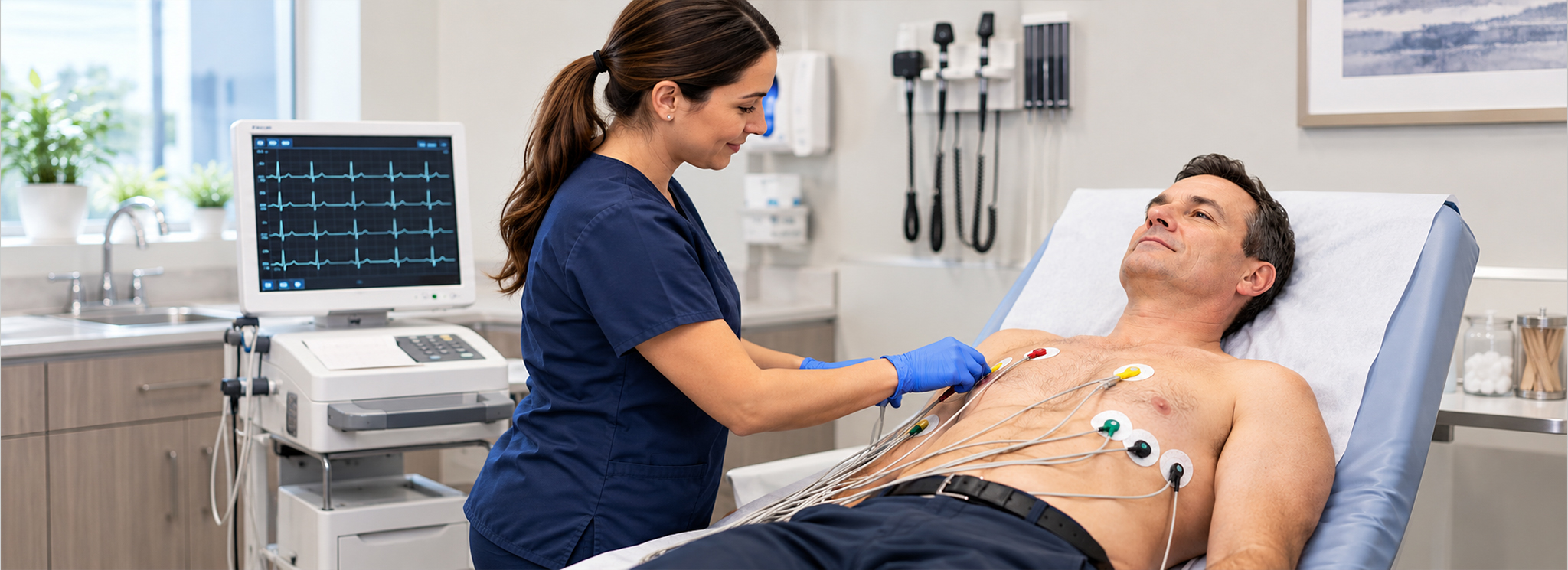
An EKG is usually simple and noninvasive. You will typically be asked about your symptoms, medical history, medications, and any known heart conditions. A clinician may also check your blood pressure, pulse, oxygen level, and temperature before deciding whether to perform the test.
During the test:
- You lie still on an exam table.
- Small adhesive electrodes are placed on your chest, arms, and legs.
- Wires connect the electrodes to the EKG machine.
- The machine records your heart’s electrical signals.
- A clinician reviews the tracing and decides what should happen next.
The test itself usually takes only a few minutes once you are set up. It should not hurt, although removing the adhesive patches may feel mildly uncomfortable.
You generally do not need special preparation. Wear a shirt that is easy to remove or adjust, avoid applying heavy lotion to the chest beforehand if possible, and bring a list of medications and supplements. If you have prior EKG results, a pacemaker, known arrhythmia, or a cardiologist, mention that during the visit.
What an EKG can and cannot show
An EKG can help identify patterns in your heart’s rhythm and electrical activity. It may show an irregular heartbeat, signs of poor blood flow, evidence of a prior or possible current heart problem, or changes that suggest a need for more testing.
However, an EKG is a snapshot. If your symptoms come and go, the tracing may look normal between episodes. A normal urgent care EKG also does not always rule out a heart attack, blood clot, rhythm disorder, or other serious condition.
Possible next steps may include:
- Reassurance and home care instructions
- Medication review or adjustment guidance
- Referral to primary care or cardiology
- Recommendation for a Holter monitor or longer rhythm monitoring
- Lab work or additional outpatient testing
- Transfer to the emergency room if findings or symptoms are concerning
This is why it is important to describe your symptoms clearly. Tell the provider when symptoms started, how long they last, what triggers them, and whether they come with chest pain, fainting, sweating, nausea, shortness of breath, or pain radiating elsewhere.
Cost and access vary by urgent care
The cost of an urgent care EKG depends on the clinic, your insurance plan, whether you are self-pay, and whether the charge includes the office visit, the EKG tracing, and the interpretation.
Some people pay a copay or coinsurance. Others receive a separate bill if the EKG is billed in addition to the visit.
Before testing, ask practical billing questions:
- Is the EKG included in the visit fee or billed separately?
- Will a clinician interpret it during the visit?
- Do you participate with my insurance plan?
- What is the self-pay price if insurance is not used?
- Will I receive a copy of the EKG for my doctor or cardiologist?
Urgent care is often chosen because it can be more accessible than scheduling a routine appointment and less intensive than an ER visit. Still, cost should never be the deciding factor when emergency symptoms are present.
If symptoms suggest a heart attack, stroke, or severe breathing problem, call 911.
How to choose the right place for heart symptoms
A simple decision framework can help, but when in doubt, err on the side of emergency care. Heart symptoms can be difficult to interpret, and even mild symptoms may matter more if you have risk factors such as known heart disease, diabetes, high blood pressure, smoking history, or a family history of early heart problems.
Use urgent care when:
- Symptoms are mild, stable, and not rapidly worsening.
- You have palpitations without fainting or severe chest pain.
- A provider requested a routine EKG for clearance or medication monitoring.
- You need same-day guidance, and your primary care office is unavailable.
- The clinic confirms that urgent care EKG services are available.
Use the ER or call 911 when:
- Chest pain is severe, persistent, or spreading.
- You faint, nearly faint, or feel suddenly very weak.
- Shortness of breath is sudden or severe.
- You have stroke-like symptoms.
- You feel something is seriously wrong or life-threatening.
An EKG at urgent care can be helpful, fast, and convenient for the right situation. The safest choice depends on your symptoms, your medical history, and how urgently you may need treatment beyond a basic heart rhythm test.
The takeaway
Urgent care centers often perform EKGs/ECGs on site, especially for non-emergency concerns such as palpitations, mild chest discomfort, dizziness, clearance exams, or rhythm checks. EKG and ECG are two names for the same electrocardiogram test, and the procedure is typically quick, painless, and noninvasive.
The most important point is triage. Urgent care can evaluate many stable symptoms, but it is not the place for heart attack symptoms or emergency heart treatment. If you believe you are having a medical emergency, dial 911 or go to the emergency room immediately.